
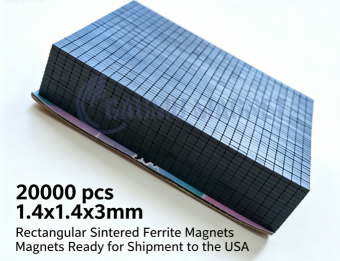
Order Update: 20,000 Ultra-Small Sintered Ferrite Magnets Ready for Shipment to the US
2nd June 2026
Order Update: 20,000 Ultra-Small Sintered Ferrite Magnets Ready for Shipment to the US
Our latest batch of ultra-small sintered ferrite magnets has successfully completed production, quality inspection, and packaging — all 20,000 pieces are now prepared for export to our US client!
Product Highlights
Material: High-performance sintered ferrite
Shape: Rectangular block (1.4×1.4x3mm)
Key Advantages: Excellent corrosion resistance, high-temperature stability, and consistent cost-effectiveness
Applications: Ideal for precision instruments, sensors, small home appliances, and electronic control modules
Quality & Logistics Assurance
Given the small size and tight tolerance requirements, we’ve implemented:
Multi-stage quality checks for dimensional accuracy
Anti-magnetic packaging & layered protection to prevent damage and magnetic interference during transit
Full pre-shipment preparation, ready for dispatch to the US factory
Market Trend & Customization
With the growing demand for miniaturized electronics and instruments, ultra-small magnets are increasingly sought-after. We specialize in custom sintered ferrite magnets to meet your exact specifications for size, magnetic performance, and temperature resistance.
Contact us today to discuss your custom magnet requirements!
shirley@gaumumagnet.com
#FerriteMagnet #SinteredFerrite #UltraSmallMagnet #PermanentMagnet #CustomMagnet #MagnetManufacturer #ElectronicComponents #ExportOrder #USAShipment #GaomuMagnet
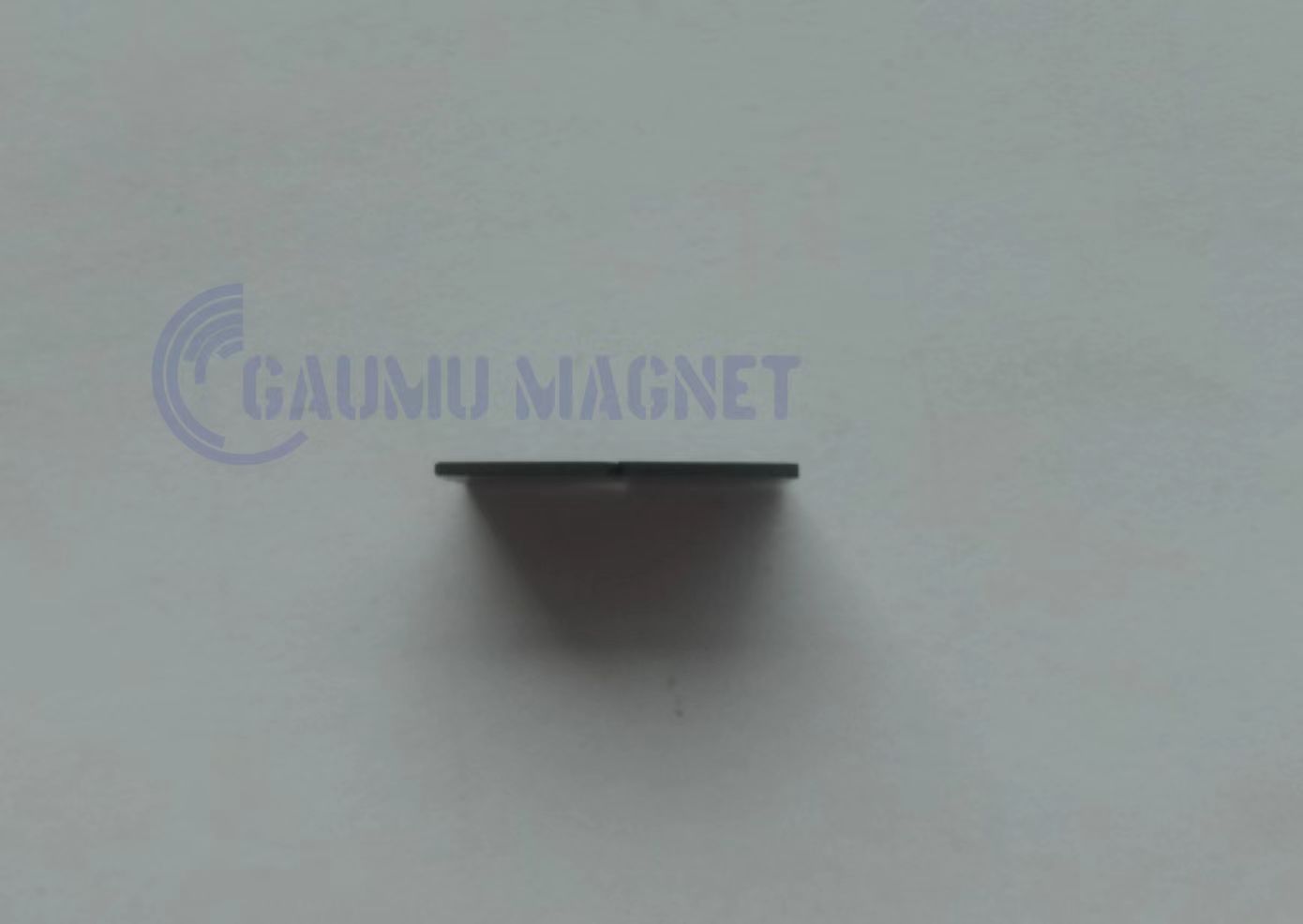
✨ Custom OEM & Custom Processing for Ultra-Thin Block Sintered Ferrite Magnets ✨
29th May 2026
Custom OEM & Custom Processing for Ultra-Thin Block Sintered Ferrite Magnets
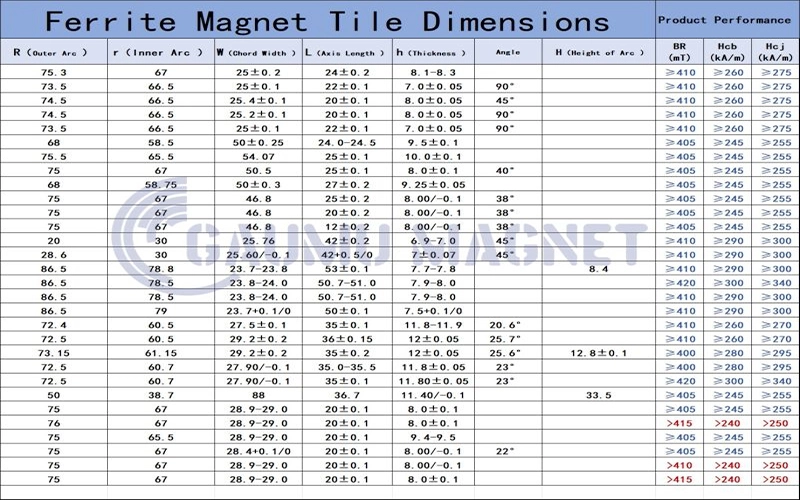
Core Accessory for Fan Motors 👉 Ferrite Arc Magnets
5th May 2026
Designed with an arc structure, specifically tailored for internal assembly of fan motors, widely compatible with various mainstream fan motor types:
– Industrial Fan Motors
– DC Fan Motors
– Bladeless Fan Motors
– Automotive Fan Motors
– Axial Fan Motors
Full Coverage of Common Permanent Magnet Materials:
Ceramic Ferrite
Available models include: Anisotropic Wet-Pressed Ferrite Arc Magnets, Sintered Anisotropic Ferrite Multipolar Rings.
Our complete standard mold size chart for fan motor ferrite arc magnets is ready, with a full range of specifications. Free samples are available for testing at any time.
As a professional permanent magnet manufacturer, we offer:
– Direct selection of existing standard molds
– Custom development with drawings or samples
– Customized magnet molds for specific motor designs
– One-time molding, precise dimensions, and stable performance
Welcome to all procurement professionals and engineers in the motor industry to send a private message for communication and win-win cooperation! For more details, please contact us via email: shirley@gaumumagnet.com
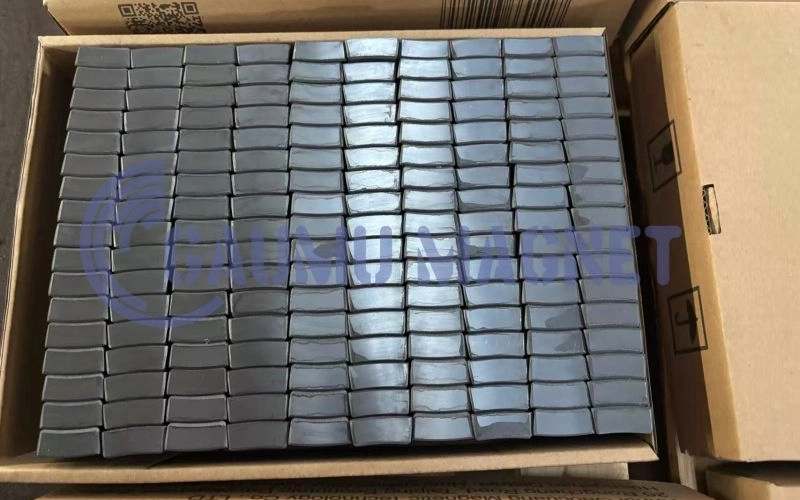
In an era of rare earth price volatility and supply chain uncertainty, does your motor design have a “Plan B” for cost control?
5th May 2026
Many engineers face a dilemma: chasing high performance with NdFeB magnets, while shouldering soaring costs and supply risks.
It’s time to re-evaluate Ferrite Magnets — not as an outdated substitute, but as a strategic choice for cost optimization and supply chain resilience.
✅ Drastic Cost Reduction
Raw material costs are only ~1/10 of NdFeB. For mass production, this means real impact on your bottom line.
✅ Stable & Secure Supply
No more dependence on scarce rare earths. Ferrite’s abundant raw materials ensure a safer, more predictable supply chain.
✅ Reliable Performance
Excellent corrosion resistance and high-temperature stability — no expensive coatings needed. Performs reliably even in harsh environments.
Through innovative magnetic circuit design, we’ve helped clients successfully replace NdFeB with ferrite in specific power ranges (e.g., 1–12kW) — for drone motors, power tools, and home appliance motors — significantly reducing BOM costs without compromising performance.
Is your next project ready for a more cost-effective power solution?
📩 DM me for a free preliminary feasibility assessment.
For quotations, customization, or technical consultation, feel free to contact us:
📧 shirley@gaumumagnet.com
Eccentric Ferrite Arc Magnets: What They Are & Their Functions
5th May 2026
In the rotor design of permanent magnet motors, magnetic arc segments are key components that directly determine magnetic field distribution and overall motor performance.
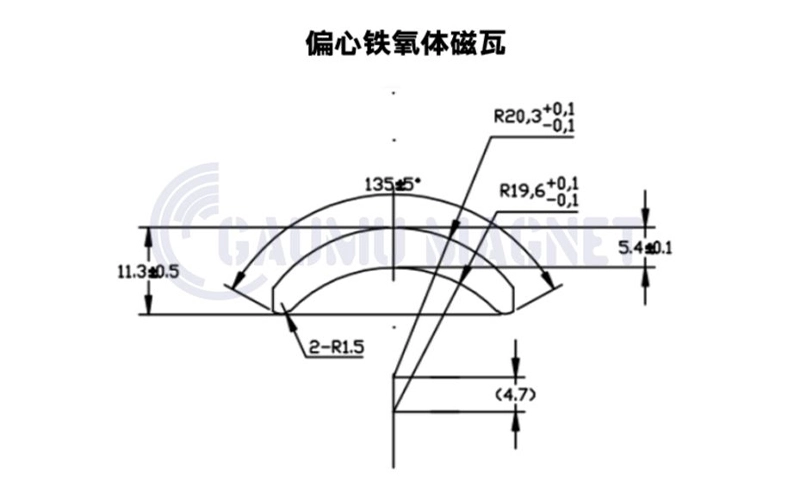
Eccentric arc magnets (also known as eccentric magnetic tiles) are an optimized structure developed based on standard equal-thickness magnets.
What is an eccentric arc magnet?
Unlike concentric arc magnets, where the inner and outer arcs share the same center, an eccentric arc magnet has different centers for its inner and outer radii.
This special geometry creates a gradually varying thickness across the magnet, from the thickest point to the thinnest point. This design is intentional, not a manufacturing defect — it is a precision-engineered magnetic circuit optimization.
Main functions of eccentric ferrite arc magnets
Produce a more sinusoidal air-gap magnetic field
Reduce magnetic harmonics effectively
Lower motor noise, vibration and cogging torque
Improve running smoothness and efficiency
Typical applications
Eccentric magnets are widely used in high-performance motors where low noise and stable operation are critical:
Inverter air conditioner compressor motors
New energy vehicle drive & auxiliary motors
High-speed, low-noise micro motors
High-efficiency permanent magnet synchronous motors (PMSM)
If you need custom eccentric ferrite arc magnets, rotor magnets, samples or quotations, welcome to contact us for professional support.
📩 shirley@gaumumagnet.com
10 FAQs About Flywheel Magnets
5th May 2026
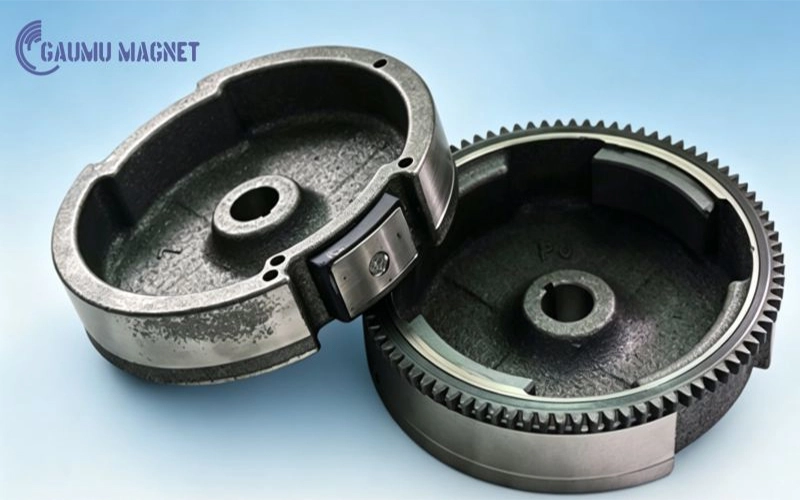
Flywheel magnets are critical magnetic components in motors, generators, and small power systems. Their performance directly impacts efficiency, stability, and service life. Here are the 10 most common questions and answers for engineers and buyers.
Q1: What is a flywheel magnet?
A flywheel magnet is a permanent magnet mounted on a rotating flywheel (magneto rotor) to generate a stable magnetic field, widely used in small engines, generators, magnetic bikes, and garden machinery.
Q2: What materials are commonly used for flywheel magnets?
The main materials are ferrite magnets (cost-effective & stable) and neodymium magnets (high magnetic strength & compact size).
Q3: What structures do flywheel magnets usually have?
They are typically designed as arc-shaped segments or one-piece magnetic rings to fit different rotor diameters and pole requirements.
Q4: How to tell if a flywheel magnet is damaged or demagnetized?
Common symptoms include:
Hard starting or unstable ignition
Reduced engine power and poor combustion
Insufficient generator output or weak lighting
These are usually caused by magnetic loss or demagnetization.
Q5: What is the function of flywheel magnets?
They induce electromotive force by rotating relative to coils, supporting ignition and charging systems, and ensuring stable operation of engines and motors.
Q6: How long do flywheel magnets last?
With proper use (no overheating, no strong impact), high-quality flywheel magnets can last for years. High temperatures or harsh environments may accelerate demagnetization.
Q7: Are all flywheel magnets the same?
No. They vary in size, arc, pole number, magnetic grade, and temperature resistance and must be matched to specific applications.
Q8: Can I replace only one damaged flywheel magnet?
Technically yes, but full set replacement is recommended to ensure uniform magnetic field distribution and avoid vibration or abnormal performance.
Q9: What temperature resistance is required?
General motors: 80–120°C
Gasoline engine flywheels: above 150°C
High-temperature applications: 180°C+
Inappropriate temperature grades lead to irreversible demagnetization.
Q10: Is stronger magnetism always better?
No. Magnetic strength must match system design. Excessively high magnetism can cause signal distortion, increased losses, and unnecessary cost.
If you need custom flywheel magnets, technical support or quotations, feel free to contact us.📩 shirley@gaumumagnet.com