
- 18th September 2026
Choosing the right ferrite magnet grade is an engineering decision, not simply a purchasing task. The grade affects magnetic output, resistance to demagnetization, temperature behavior, motor efficiency, and product cost. A magnet that works well in a small appliance may not be suitable for an automotive motor or outdoor generator.
Ferrite magnets are widely used because they offer a practical balance of performance, corrosion resistance, heat stability, and cost. At GAUMU MAGNET, we help customers select ferrite materials according to their drawings, operating conditions, magnetic targets, and production needs.
Why Ferrite Magnet Grades Matter
Different ferrite grades can have noticeably different values for remanence, coercivity, and maximum energy product. These figures describe how much magnetic energy a material can provide and how well it can keep that energy under heat, current, and external magnetic stress.
Magnetic properties behind the grade
Three values are especially important when comparing ferrite magnet grades:
- Remanence, Br: The magnetic flux density left after magnetization.
- Normal coercivity, Hcb: The resistance to ordinary demagnetization.
- Intrinsic coercivity, Hcj: The resistance to deep or irreversible demagnetization.
- Maximum energy product, (BH)max: The amount of magnetic energy available from the material.
A higher Br can support stronger output, but it is not always the only target. For a motor exposed to sudden load changes, Hcj may be more important. For a compact design, (BH)max can help engineers compare how much magnetic work the material can provide within a limited volume.
The grade must match the working condition
A magnet should be selected according to the whole application. Temperature, air gap, current, rotor speed, vibration, load changes, and available space all affect the result. Using the highest grade for every project may increase cost without improving the finished product.
For example, a simple household motor may work well with a general-purpose ferrite grade. A high-speed BLDC motor, automotive auxiliary motor, or charging-related motor may need stronger magnetic performance and better resistance to demagnetization.
Main Ferrite Magnet Grades and Their Uses
Ferrite magnet grades are not arranged in a simple “low to high” order. Some grades offer higher remanence, while others provide stronger intrinsic coercivity or better temperature stability. The right choice depends on which property controls the risk in your design.
GC-3 and GC-3J for demagnetization resistance
GC-3 has a remanence of about 360-380 mT, intrinsic coercivity of about 315-340 kA/m, and a maximum energy product of approximately 25.6-27.8 kJ/m³. It can be useful when the design needs good resistance to demagnetization under changing loads.
GC-3J offers a lower maximum energy product but higher intrinsic coercivity, with Hcj around 355-380 kA/m. This makes it worth considering when protection against irreversible demagnetization is more important than maximum magnetic output.
These grades may suit selected motors, magnetic assemblies, and applications where the magnet has enough working volume.
GC-1 for balanced magnetic output
GC-1 provides remanence of approximately 390-405 mT and a maximum energy product of around 30.2-32.6 kJ/m³. It offers a useful balance between magnetic output and cost for general motor and industrial designs.
This type of balanced grade can be appropriate for applications where the operating temperature and magnetic load are moderate. It may also work well in designs that do not require the highest field strength but still need consistent production performance.
GC-5H for automotive and fitness motors
GC-5H has remanence of about 399-420 mT and a maximum energy product of approximately 31.0-33.4 kJ/m³. It is commonly considered for automotive auxiliary motors, treadmill motors, lawn equipment, and other systems that face vibration or repeated load changes.
In automotive motor designs, the magnetic circuit may be adjusted to produce a smoother waveform. The pole arc, arc height, and air gap must work together. A suitable GC-5H magnet can help the motor maintain stable output as temperature and load change.
GC-6B and GC-6H for demanding field conditions
GC-6B provides remanence of about 400-420 mT, Hcb around 268-295 kA/m, and Hcj around 290-310 kA/m. It is suitable for applications that need stable output and stronger resistance to changing magnetic conditions.
This grade is often considered for outdoor generators and related motor systems. In a generator, steady magnetic behavior affects voltage stability and output at the rated speed. The grade should be selected together with the pole design, rotor structure, and heat path.
GC-6H offers higher coercivity ranges in some parameters and may be considered when stronger resistance to demagnetization is required.
GC-7B, GC-7H, GC-9B, and GC-9H for higher performance
Higher ferrite grades can support applications that need stronger magnetic output or improved performance in a limited space. GC-9B has remanence of approximately 420-435 mT and a maximum energy product of about 35.1-38.08 kJ/m³. GC-9H reaches a maximum energy product of about 35.6-39 kJ/m³.
These grades can be considered for BLDC appliance motors, compact generators, charging-related equipment, and high-output motor designs. The final choice still depends on temperature, current, air gap, and demagnetization risk. A higher grade cannot correct a weak magnetic circuit or poor mechanical fit.
How to Choose a Grade for an Engineering Project
A reliable selection process begins with application data. Buyers should provide more than a part number or a basic drawing. The supplier needs to know how the magnet will work after assembly, not only how it looks before installation.
Start with the application conditions
Before requesting a quotation, collect the following information:
- Motor or device type
- Magnet shape and working dimensions
- Operating temperature
- Maximum current and load condition
- Rotor speed or movement cycle
- Required magnetic field or torque
- Magnetization direction
- Air-gap size
- Expected service life
- Annual quantity and tolerance requirements
This information helps the supplier compare materials more accurately. It also prevents a common mistake: selecting a grade only because its Br value looks high.
Compare Br, Hcb, Hcj, and (BH)max together
A useful selection usually involves trade-offs. Br affects available magnetic flux. Hcb helps the magnet resist normal demagnetization. Hcj is important when the magnet may experience high temperature or strong opposing fields. (BH)max indicates the energy available from the material.
For a motor exposed to sudden loads, Hcj may deserve special attention. For a compact motor, Br and (BH)max may carry more weight. For outdoor equipment, temperature and corrosion resistance may matter just as much as magnetic strength.
Check size and tolerance after grade selection
Ferrite is a hard ceramic material. It is strong in compression but more brittle than many metals. Shape, grinding, surface finish, and tolerance must be considered during design.
For wet-pressed ferrite arc magnets, ground dimensions can reach approximately ±0.1 mm in selected features, while unground tolerances are wider. The actual tolerance should be agreed according to the drawing, manufacturing process, and assembly requirement.
Product Categories and Common Industries
The same ferrite material can appear in very different products. A cylinder magnet, block magnet, ring magnet, and arc magnet do not create the same field pattern. Product shape is part of the magnetic design, not an afterthought.
Common product forms
GAUMU MAGNET supplies ferrite products in forms such as:
- Ceramic ferrite magnets
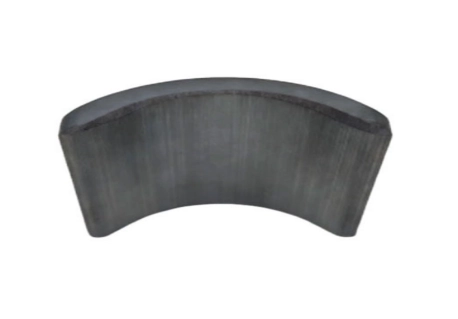
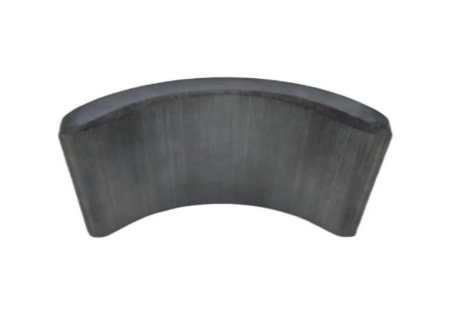
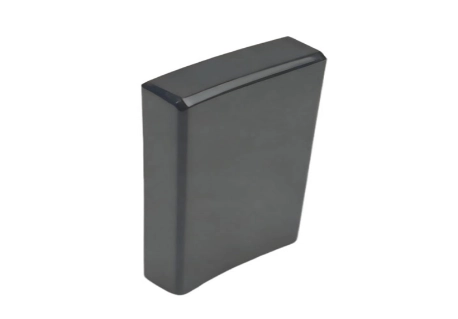
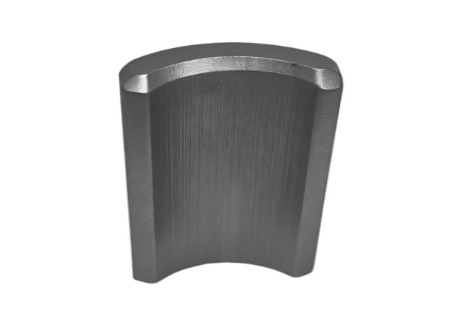
- Ferrite arc magnets
- Ferrite motor magnets
- Ferrite block and bar magnets
- Ring and custom-shaped magnets
Our product range supports applications in automotive motors, household appliances, power tools, fitness equipment, industrial controls, and generator systems.
Automotive and appliance motors
Ferrite magnets are used in window lifter motors, seat adjustment motors, sunroof motors, wiper motors, fans, pumps, and appliance drives. GC-5H can be suitable for some automotive auxiliary motors, while GC-9B may be considered for compact BLDC applications where higher magnetic output is needed.
In household appliances, ferrite magnets help control cost while offering good heat resistance and stable long-term performance. The final selection should consider noise, speed, current, and the shape of the motor housing.
Generators and industrial equipment
Permanent magnet synchronous generators require careful coordination between magnet grade, pole count, rotor structure, and electrical design. Ferrite can be attractive in these systems when the design has enough magnetic volume and the project values cost stability and material availability.
Outdoor generators, charging-related motors, power tools, lawn equipment, and fitness machines also benefit from ferrite’s resistance to corrosion and demagnetization. For related conductive components, projects may also require brass strip, high performance alloy strip, brass C2680, or C7025 material.
Industry Trends Affecting Ferrite Selection
Engineering teams are paying closer attention to material supply, energy use, and product life cycle. The growth of electric motors in vehicles, appliances, automation, and distributed power systems has made magnetic material selection more important.
Rare-earth-free designs are gaining attention
Ferrite magnets do not rely on rare-earth elements. This gives them an advantage when companies want more predictable material costs or a simpler supply chain. Ferrite may not replace every high-power magnet, but it can be a strong choice when the product has enough space for a larger magnetic volume.
Efficiency depends on the whole motor design
Magnet grade alone does not decide motor efficiency. Rotor geometry, pole arc, winding design, air gap, core loss, bearing quality, and control method all play a role. A carefully selected ferrite magnet can perform well when the motor is designed around its actual magnetic properties.
At GAUMU MAGNET, we work with customers on grade, size, shape, and magnetization direction. Our goal is to fit the magnet to the engineering project rather than force every application into one standard material.
Conclusion
Choosing among ferrite magnet grades requires more than comparing one magnetic value. Engineers should study remanence, coercivity, energy product, temperature, air gap, pole arc, and final application together. GC-3 and GC-3J may suit designs that need strong demagnetization resistance. GC-5H is useful for many automotive and fitness motors, while GC-6B, GC-7, and GC-9 grades can support more demanding output requirements. Ferrite remains attractive because it combines reasonable cost, corrosion resistance, heat stability, and a rare-earth-free supply path. With accurate application data and a capable supplier, a ceramic ferrite magnet can deliver reliable performance without unnecessary material cost.
FAQs
Q: Which ferrite magnet grade is strongest?
A: GC-9H generally provides one of the highest listed ferrite energy products.
Q: Is GC-5H suitable for automotive motors?
A: Yes. GC-5H is widely considered for automotive auxiliary motor applications.
Q: Can GAUMU MAGNET recommend a ferrite grade?
A: Yes. We can recommend grades using drawings, samples, operating conditions, and performance targets.
Table of Contents
Recent Posts
Why Arc Ferrite Magnets Are Ideal for Rotational Motors
Ceramic Disc Magnet Manufacturer | Custom Ferrite Magnets
Ferrite Block Magnets Manufacturer | Custom Industrial Motor Magnets
FAQ
What is information we need before quotation for magnet?
2) Size and shape, and magnet tolerances, normally International tolerance is +/-0.1mm
4) Magnetization direction
5) Quantities required.
6) Magnet application