
- 5th May 2026
Air-gap Magnetic Field Produced by 2-pole and 4-pole Magnetic Tiles Under Different Magnetization Methods
In permanent magnet motors, multiple magnetic tiles (one tile per pole) are commonly used, mainly made of NdFeB or ferrite. The magnet is composed of 2 or even dozens of magnetic tiles. The commonly used magnetization methods include:
📌 Parallel Magnetization
📌 Radial Magnetization
This paper focuses on the air-gap magnetic field generated by 2-pole and 4-pole magnetic tiles under the two magnetization methods mentioned above.
🔍 Case Study: 3 kW, 100 kr/min High-speed Motor
▶️ 2-pole Magnetic Tiles
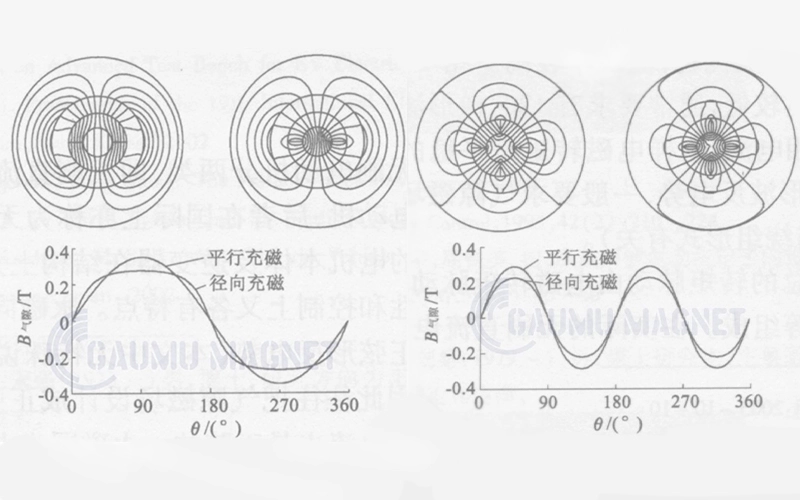
The figure below shows the air-gap magnetic field distribution waveforms under different magnetization methods:
– Radial Magnetization:
• Air-gap magnetic field: Close to a trapezoidal waveform
• Fourier decomposition results:
– Fundamental component: Only 91.2% of that under parallel magnetization
– 3rd harmonic: 16.3% of the fundamental component
– 5th harmonic: 3.8% of the fundamental component
– 7th harmonic: 1.0% of the fundamental component
• Conclusion: The 5th and higher-order harmonics are very small.
▶️ 4-pole Magnetic Tiles
The figure below shows the air-gap magnetic field distribution waveforms under different magnetization methods:
– Key Feature: The 5th and higher-order harmonics are negligible.
– Parallel Magnetization: 3rd harmonic = 4.2% of the fundamental component
– Radial Magnetization: 3rd harmonic = 6.2% of the fundamental component
💡 Critical Finding
Compared with radial magnetization, parallel magnetization can increase the fundamental air-gap magnetic field by 26.7%.
📊 Final Analysis
Parallel magnetization makes the air-gap magnetic field close to a sinusoidal distribution, and is beneficial to improving the fundamental component of the magnetic field and the effective electromagnetic torque.
Table of Contents
Recent Posts
Why Arc Ferrite Magnets Are Ideal for Rotational Motors
Ceramic Disc Magnet Manufacturer | Custom Ferrite Magnets
Ferrite Block Magnets Manufacturer | Custom Industrial Motor Magnets
FAQ
What is information we need before quotation for magnet?
2) Size and shape, and magnet tolerances, normally International tolerance is +/-0.1mm
4) Magnetization direction
5) Quantities required.
6) Magnet application